

AI interview agent
Prototype, sample dataThis is a Scaylar prototype built to show how an AI interview agent works, with sample data on screen. A voice agent interviews staff one at a time about the tasks that fill their week, reads back what it heard, and combines the confirmed interviews into a ranked map of where AI agents could take on work. The organization, the people and every number are made up, and the prototype uses no microphone and calls no AI service.
( USE CASE )
Who it is for and the problem
Consultancies, and the in-house teams that run change programs, when they need to know where AI agents fit across a large organization.
Workshops and surveys miss how work actually gets done. A workshop hears from a few managers; a survey gets short answers to fixed questions. The detail that decides whether an agent can help (which systems a task touches, where it gets stuck, who it is handed to) comes out in conversation, and there are never enough interviewers to talk to everyone.
The agent holds that conversation with each person, records it in a structured form and adds it to one picture of the organization.
( STEP BY STEP )
How it works
The steps describe how a production build would work. The prototype plays them back with sample data and timers.
Step 01
Interview each person
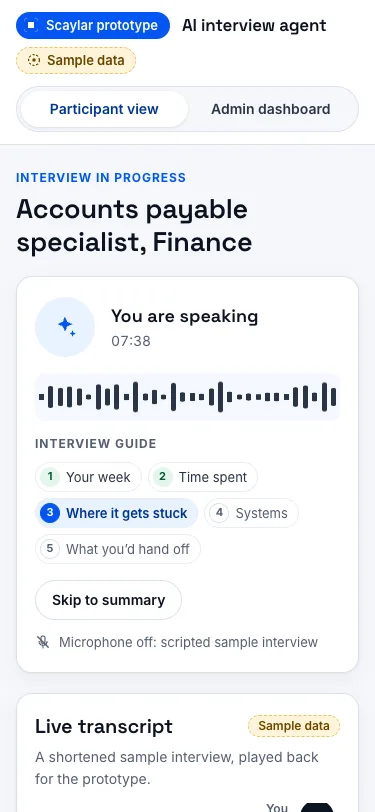
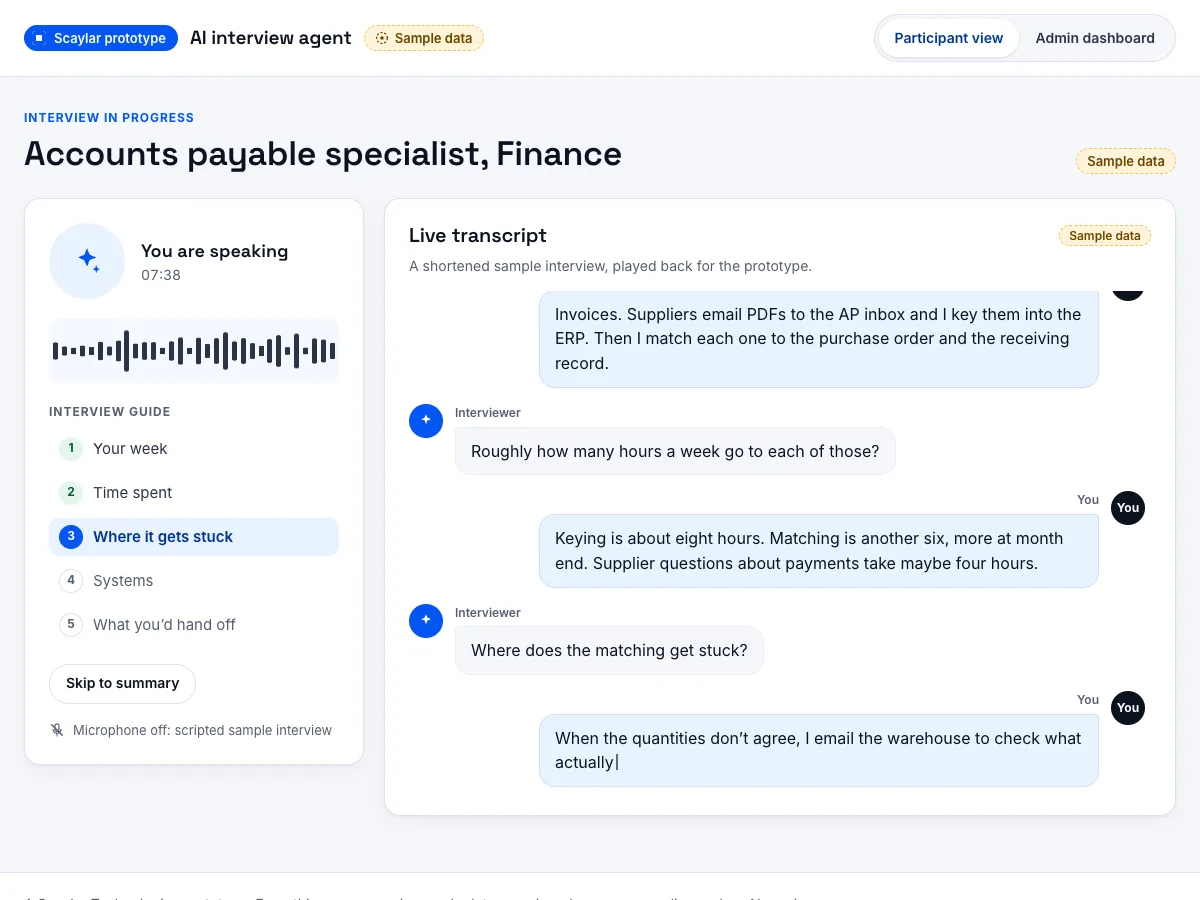
Each person gets an invitation and talks to the agent when it suits them. The agent follows a short guide: their week, the time each task takes, where it gets stuck, the systems involved and what they would hand off. It asks follow-up questions and lets people interrupt, the way a good interviewer does. In the prototype the interview is a scripted sample played back on a timer.
Step 02
Read it back and confirm
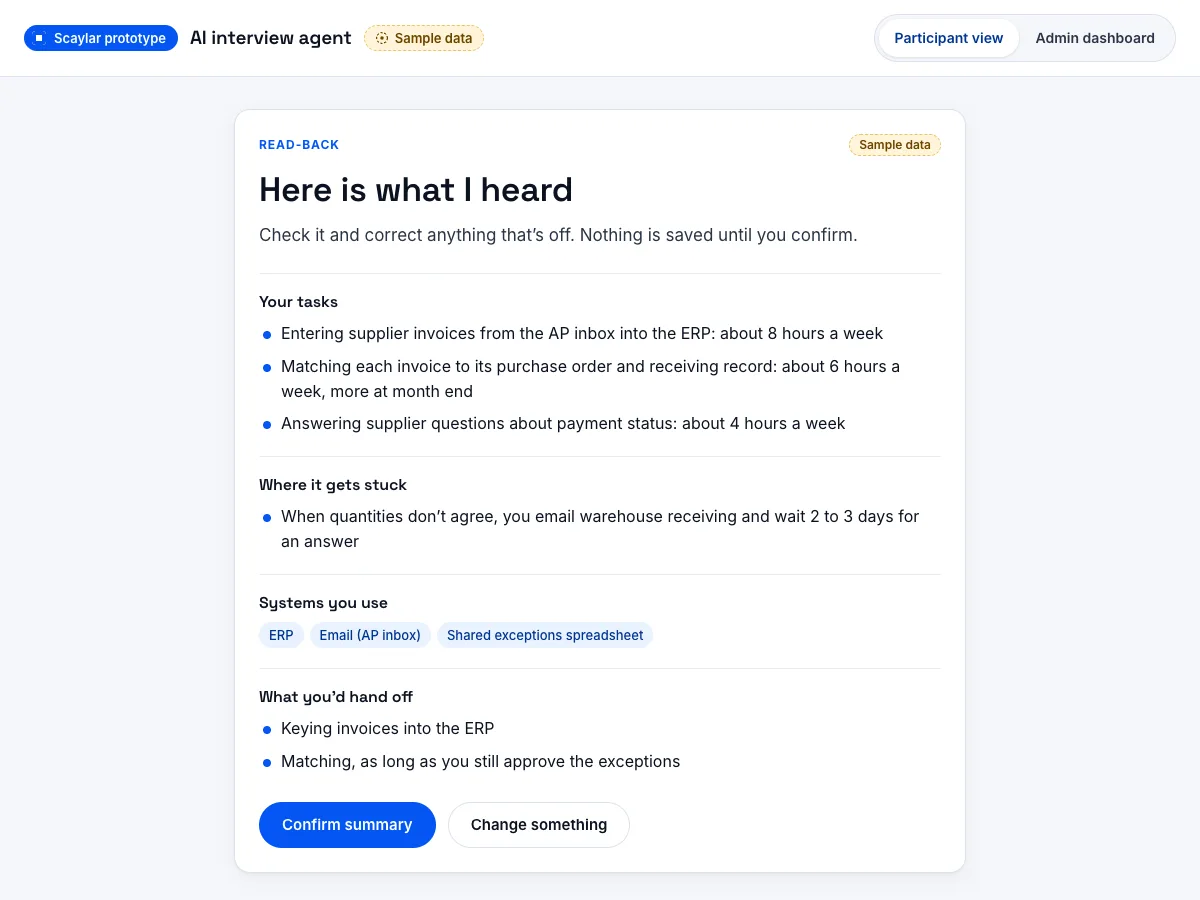
At the end the agent reads back what it heard: the tasks and the hours they take, where the work gets stuck, the systems used and what the person would hand off. The participant confirms it or corrects it before anything is saved. Only confirmed summaries count toward the map.
Step 03
Record the interview in a structured form
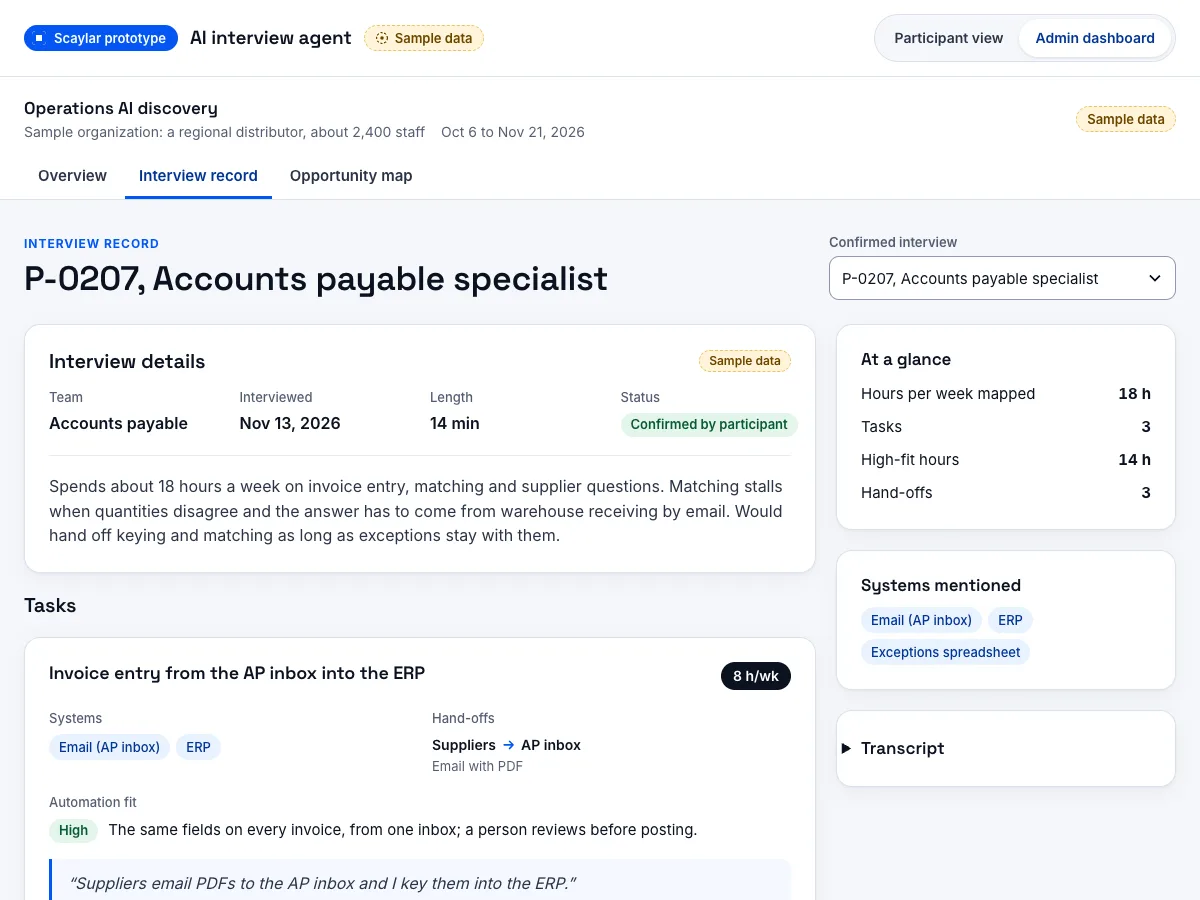
In a production build, each confirmed interview becomes a record: tasks with hours per week, the systems each one uses, the hand-offs between teams, an automation fit with the reason for it, and the quote behind each point. The full transcript stays attached, so any line of the record can be checked against what was said.
Step 04
Follow the campaign on one screen
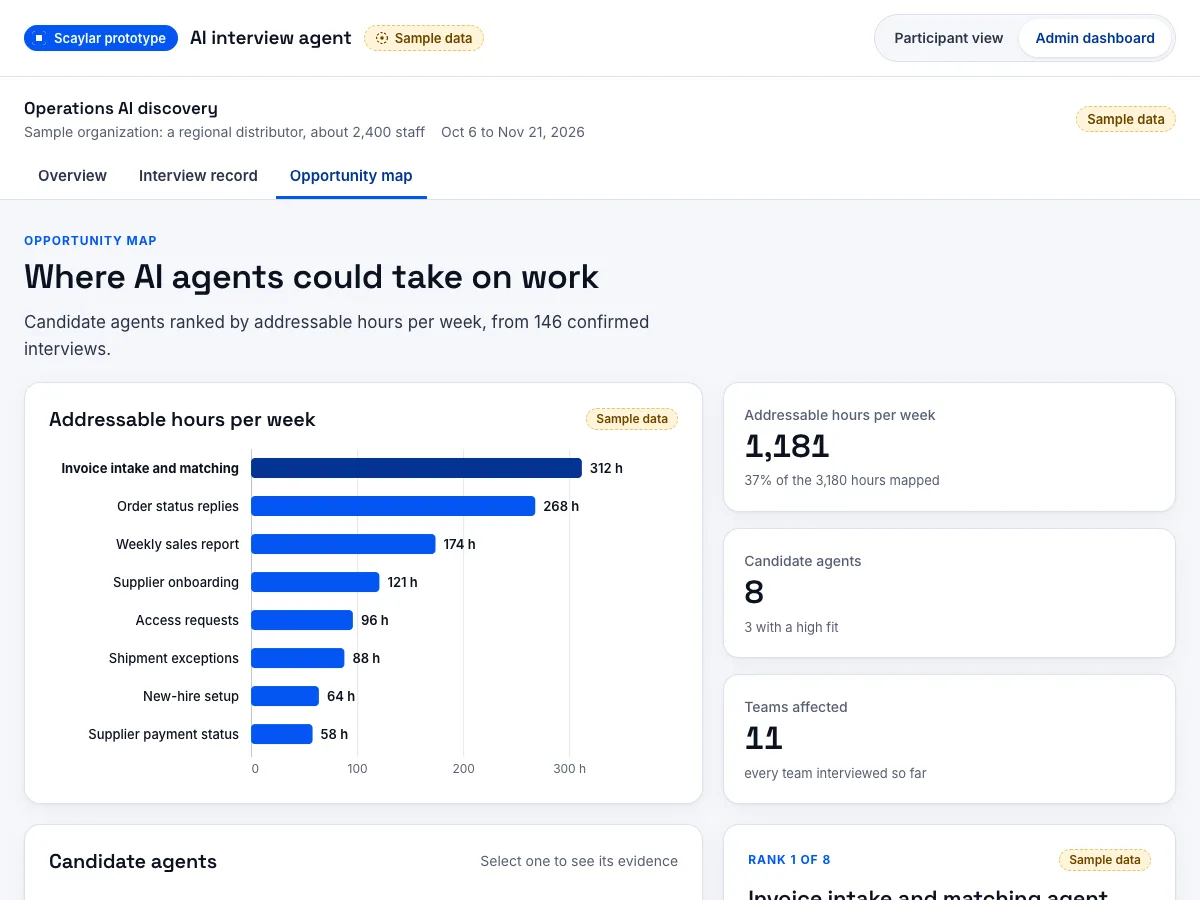
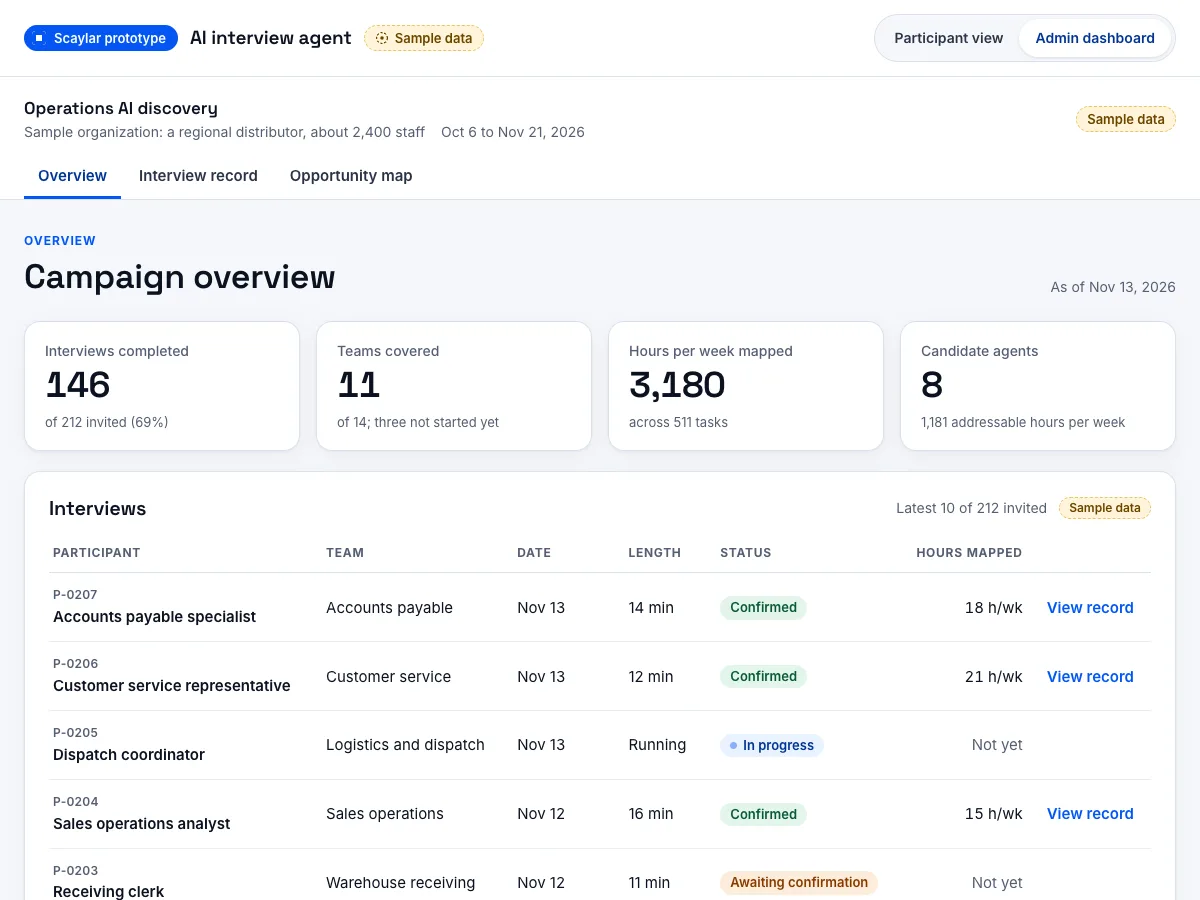
The admin view shows who has been interviewed and who has not, how much work has been mapped, and which teams are not covered yet. The people running the discovery can see the gaps and send reminders before the results are read.
Step 05
Rank the candidate agents, with the evidence
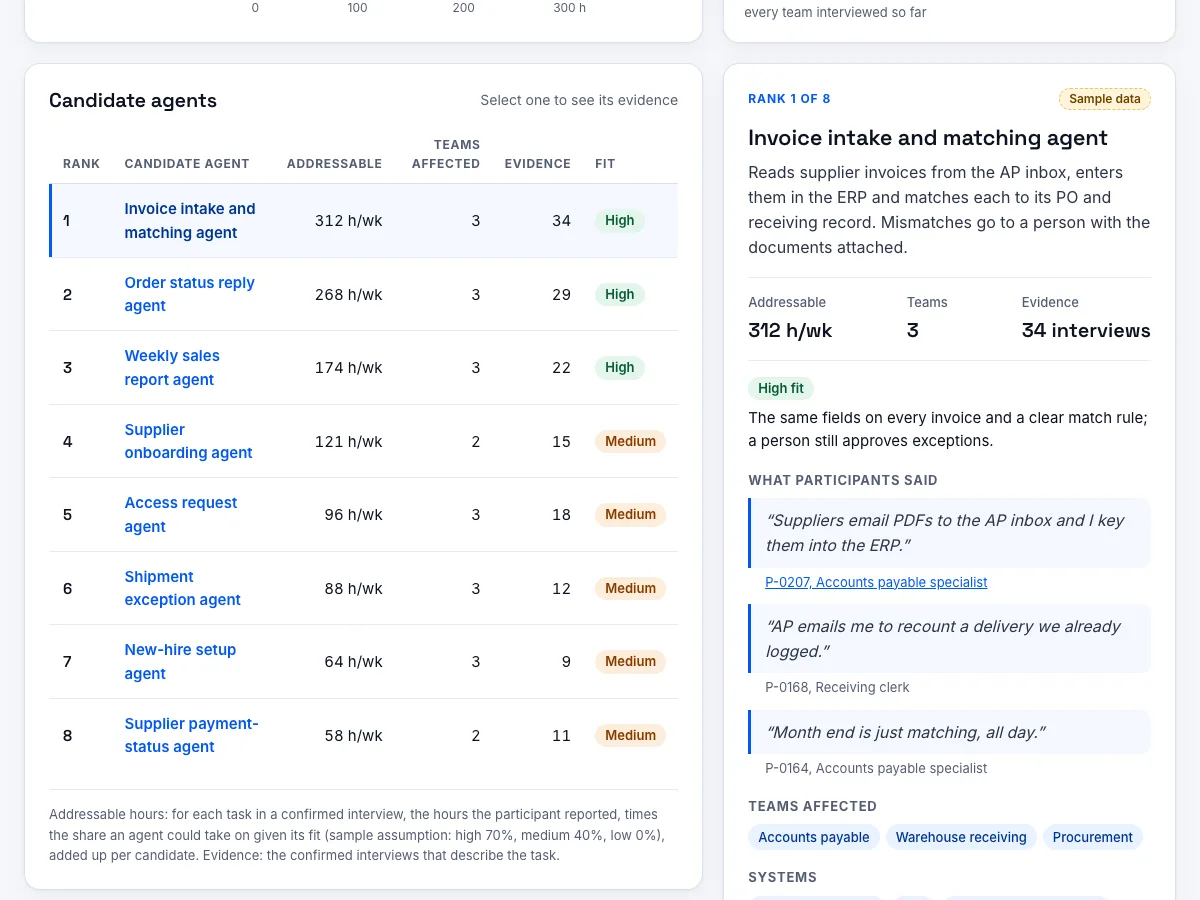
In a production build, the confirmed interviews are combined into a ranked list of candidate AI agents, each with the hours per week it could take on, the teams involved and how well the work suits an agent. Select a candidate in the prototype to see the quotes and interviews it is built from, so every line of the map can be traced back to what people said.
( WHAT WE AIM FOR )
Targets for a production build
What a production build would be designed and measured against. They are targets, not results: the prototype runs on sample data.
- Target: hundreds of interviews in a week, run side by side, without adding interviewers.
- Target: under $5 per 20-minute interview in model and voice costs.
- Target: every candidate agent backed by quotes from confirmed interviews.
( THE BUILD )
What we would build it with
A large language model (LLM)
To follow the interview guide, ask follow-up questions, write the read-back and turn each transcript into a structured record.
A voice layer
Speech-to-text and text-to-speech with interruption handling, in the browser or over the phone.
Your own systems
Invitations sent from your staff directory, and records stored where your team can query and export them.
A review step
Each participant confirms their own summary, and an analyst reviews the candidate agents and their evidence before anything is presented.
Logs and cost tracking
Every interview keeps its consent, transcript, record and cost, so the campaign’s spend and every number on the map can be checked.
( OUR WORK )
Built on work we have shipped
- Live AI voice interviews with interruption handling and a five-part scoring rubric, for a hiring platform.
- An AI receptionist that books onto a business’s own calendar during the call.
Open the prototype
It runs in your browser on sample data: nothing you click or type is sent anywhere. If you have a process like this one, book a call and we will tell you plainly whether an agent is the right tool for it.
More case studies: AI trend-report agent · AI learning guide