

AI learning guide
Prototype, sample dataThis is a Scaylar prototype built to show how an AI learning guide works, with sample data on screen. A learner says what they want to be able to do, answers one question, and gets an ordered path of specific tutorials from the library, with the reason each one comes where it does. The tutorials and the guide’s replies are made up and scripted, and the prototype calls no AI service.
( USE CASE )
Who it is for and the problem
Training providers and internal academies whose libraries have grown past what a learner can browse: tutorials, videos and labs across many topics and levels.
A catalog answers a search, not a goal. A search for “cloud” returns a long list in no particular order, so people pick at random, repeat what they already know or give up. The help a good instructor gives, “take these, in this order, and skip that one”, does not reach every learner.
The guide gives that help on demand, and only from what is in the library.
( STEP BY STEP )
How it works
The steps describe how a production build would work. The prototype plays them back with sample data and timers.
Step 01
Ask what the learner wants to do
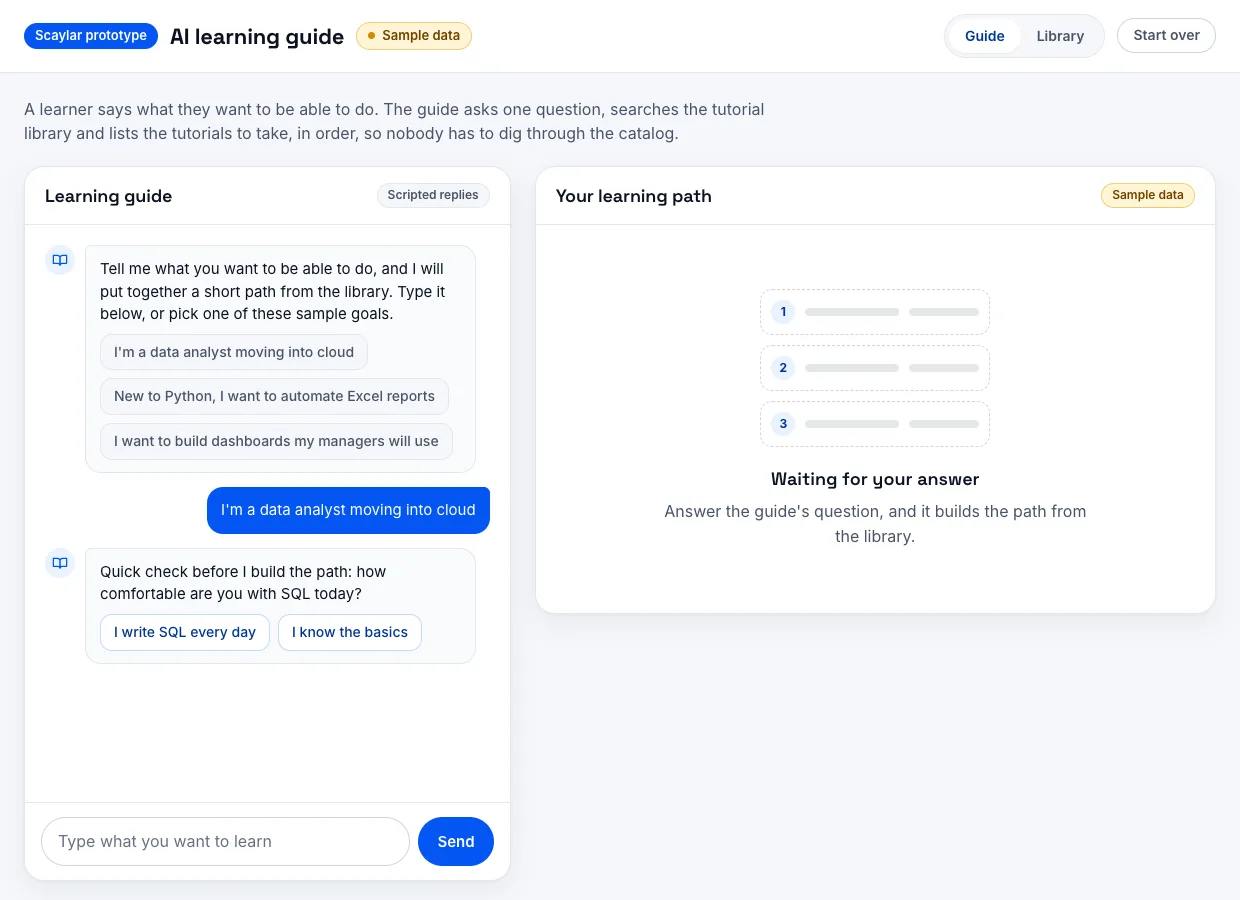
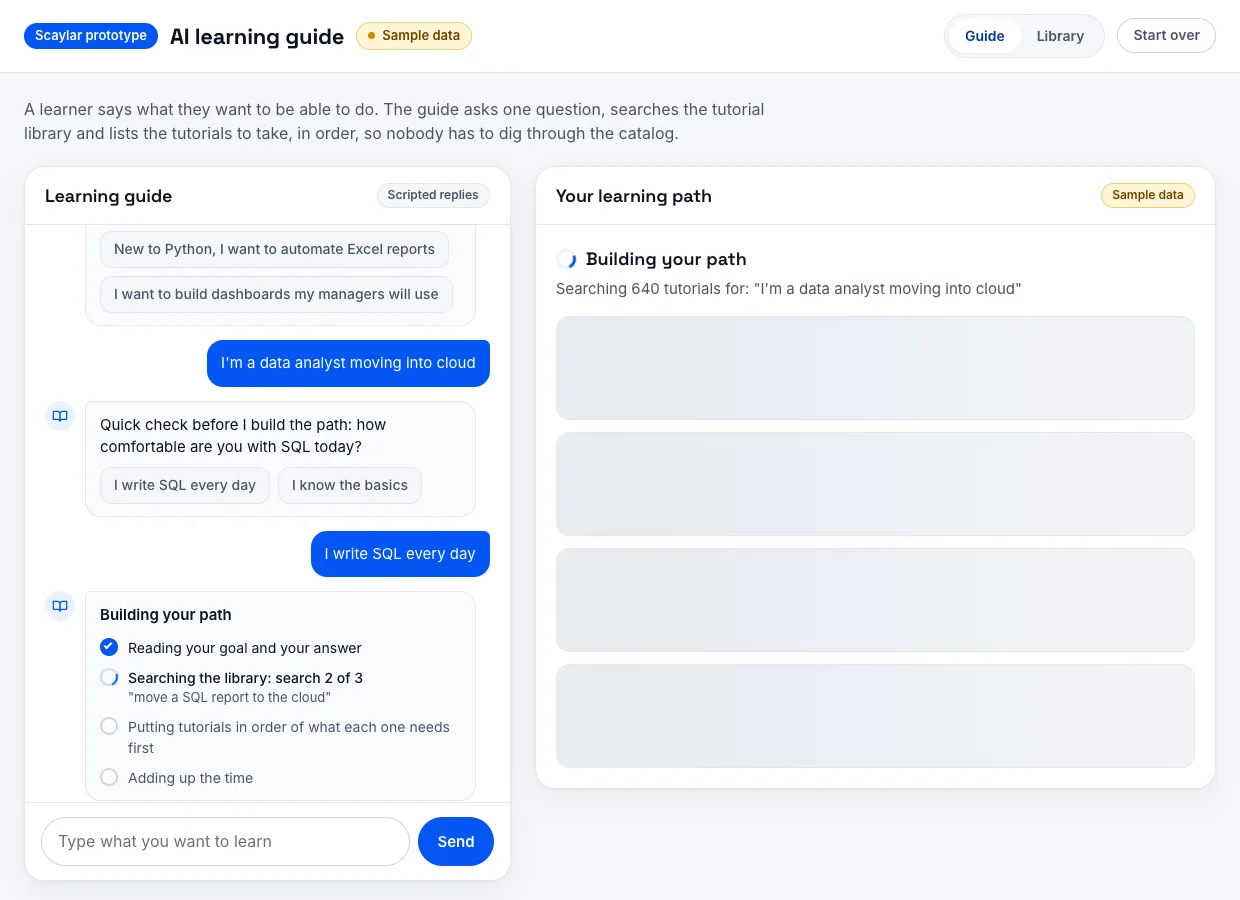
The learner types a goal in their own words or picks a sample one. In a production build, the guide then asks the one question that changes the path most, such as how comfortable they are with SQL today, and offers answers to tap; in the prototype a typed goal is matched to the closest sample goal, and its question is scripted. One well-chosen question is enough to tell a needed refresher from a step the learner can skip.
Step 02
Search the library
The guide turns the goal and the answer into a few targeted searches of the tutorial library and shows its progress while it works. In the prototype the search is a timer over a small sample library; in a production build it runs against an index of the real catalog.
Step 03
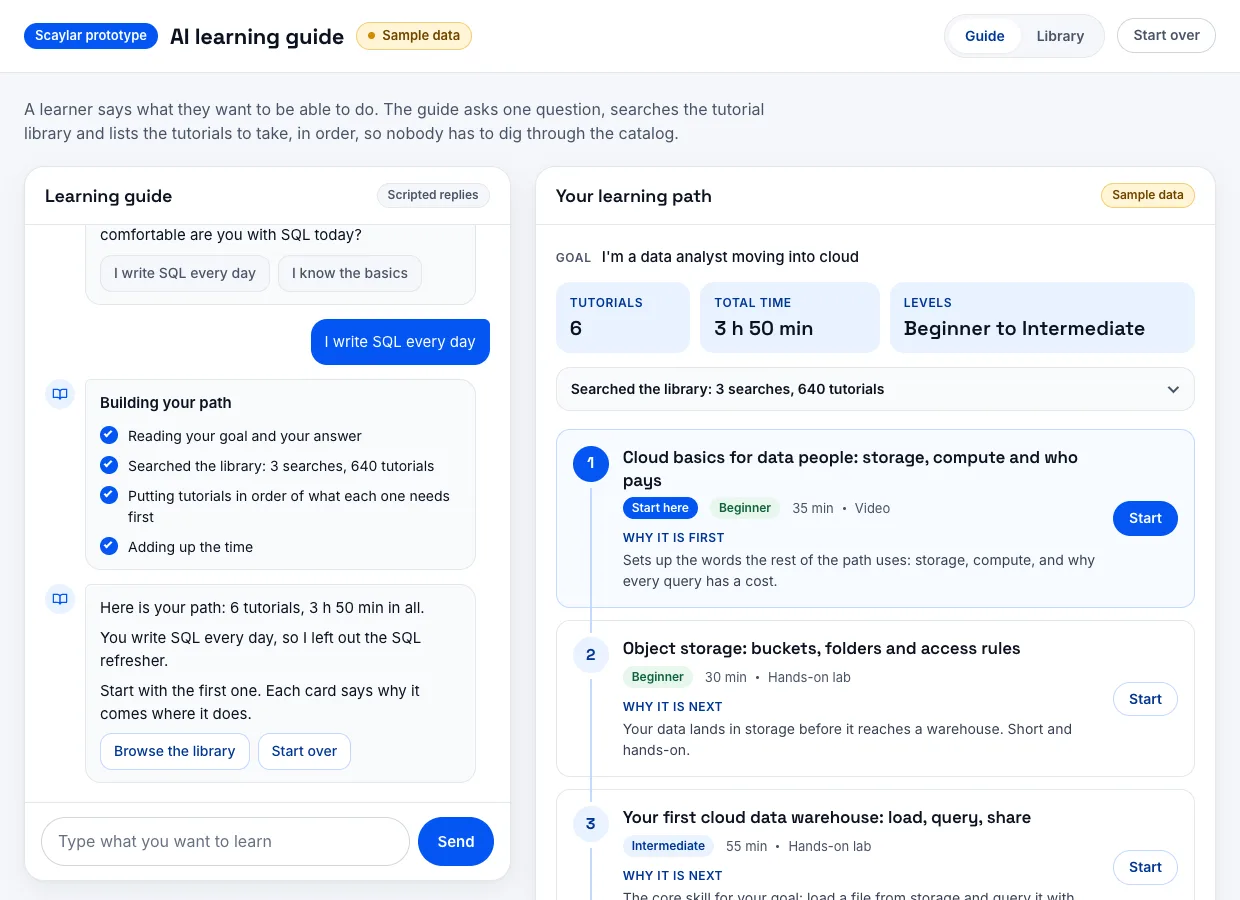
Return an ordered path, with a reason for each step
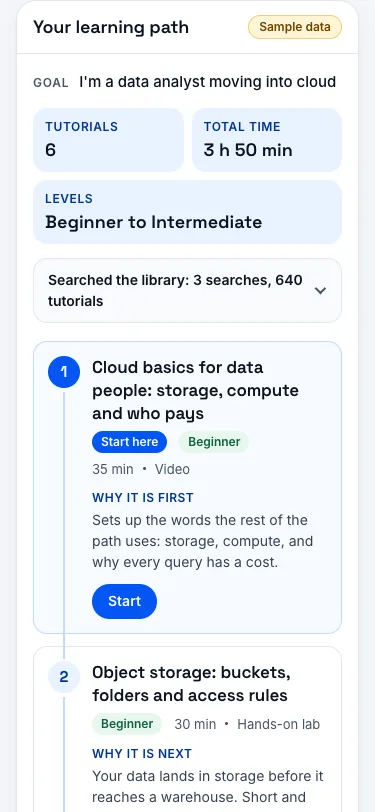
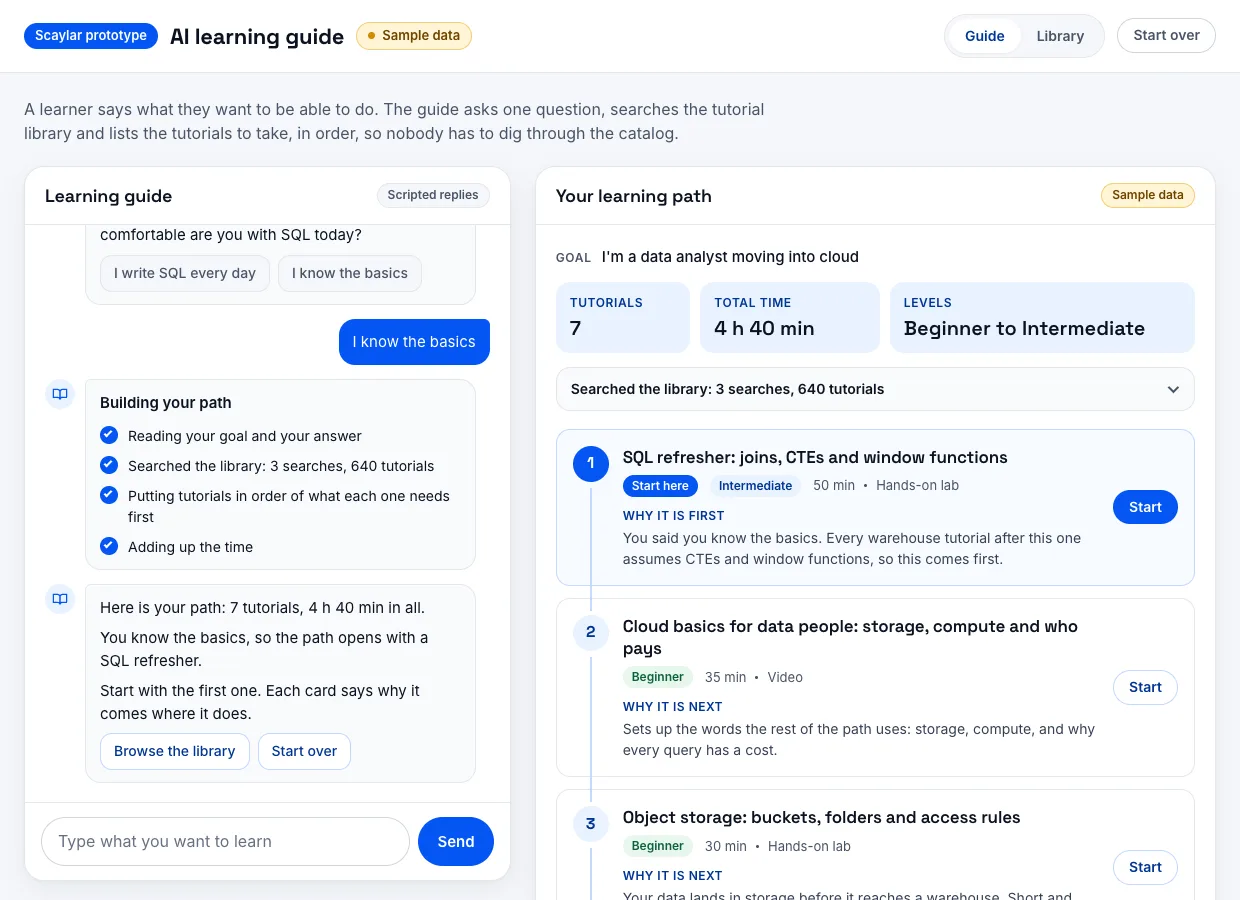
The result is a numbered path of specific tutorials, each with its level, length and format and a line on why it comes where it does. The total time is added up, so the learner knows what they are taking on. When the answer changes, the path changes with it: a learner who knows only the basics of SQL gets a refresher first, and the guide says why.
Step 04
Keep the library as the source of truth
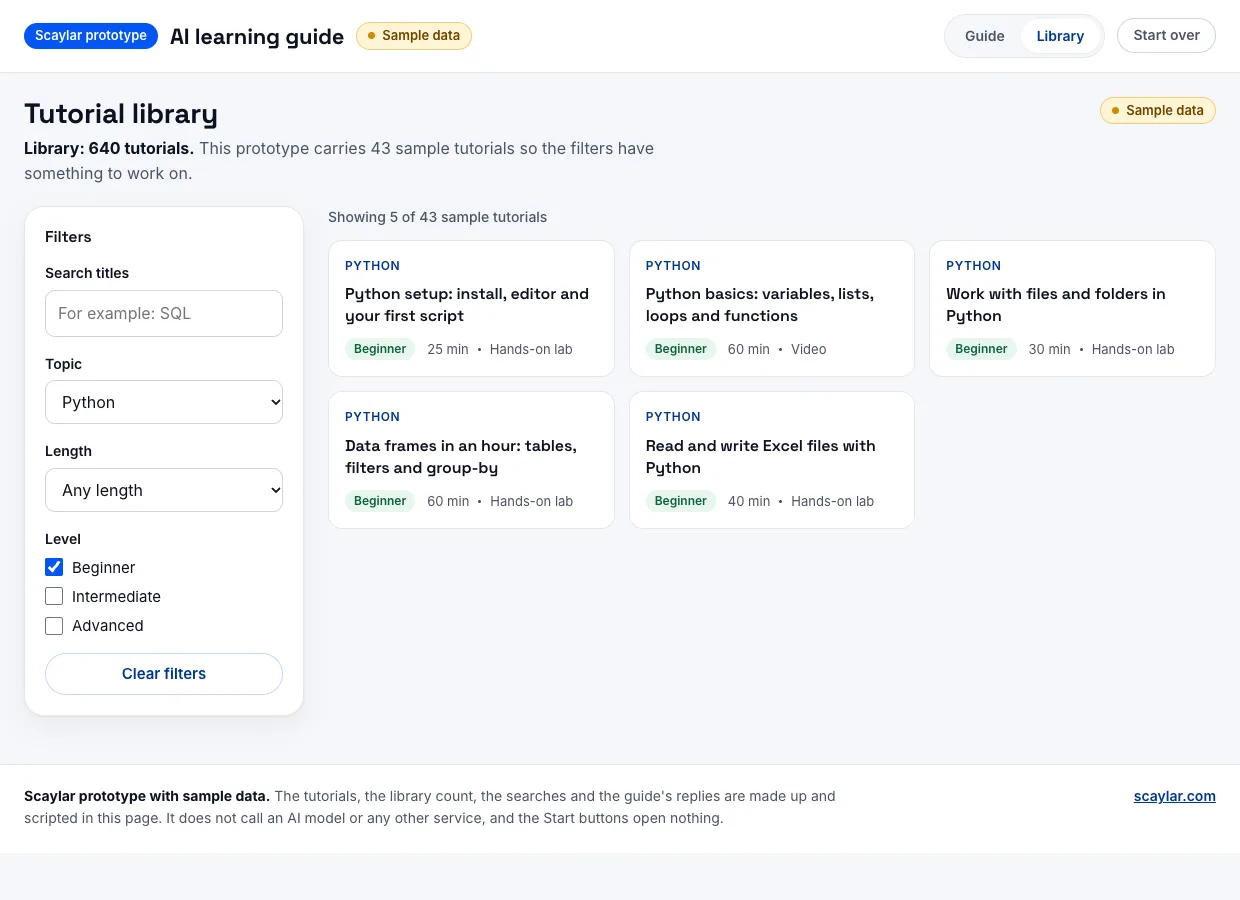
Every recommendation is a tutorial that exists in the library, and the library stays browsable with filters for topic, length and level. In a production build, a retired tutorial drops out of the paths at the next catalog sync, and the guide never recommends a course the library does not hold. In the prototype the Start buttons open nothing.
( WHAT WE AIM FOR )
Targets for a production build
What a production build would be designed and measured against. They are targets, not results: the prototype runs on sample data.
- Target: a personalized path in under 10 seconds.
- Target: every recommendation links to a real tutorial in the library.
- Target: less time spent searching, measured from search logs before and after.
( THE BUILD )
What we would build it with
A large language model (LLM)
To read the learner’s goal, choose the one question worth asking and write the reason for each step. It chooses from search results; it does not make up titles.
Your own catalog
Your tutorial library and its details (topic, level, length, prerequisites) as the only source of recommendations, indexed for semantic search.
A review step
Your training team reviews the paths for common goals before launch, and can pin or exclude tutorials for a goal.
Logs and cost tracking
Every conversation, search and recommendation is logged with its cost, so you can see which goals come up and where the library has gaps.
( OUR WORK )
Built on work we have shipped
- A content team that publishes AI-generated courses from its own source documents without a developer.
- Semantic matching between people and roles for a talent platform.
Open the prototype
It runs in your browser on sample data: nothing you click or type is sent anywhere. If you have a process like this one, book a call and we will tell you plainly whether an agent is the right tool for it.
More case studies: AI trend-report agent · AI interview agent